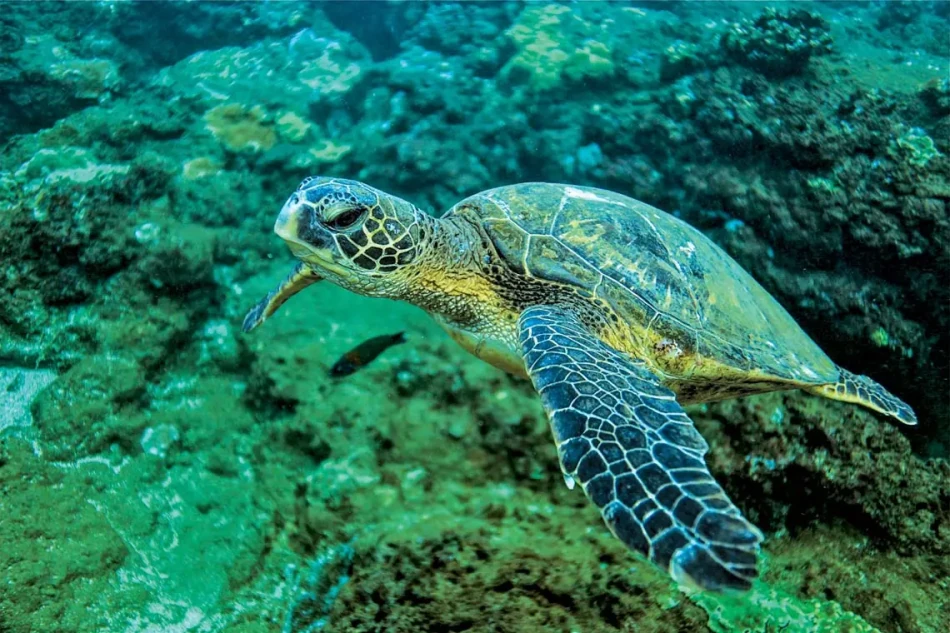

The green sea turtle population has shown a successful recovery which stands as one of the most successful marine conservation achievements of the last few decades.
The International Union for Conservation of Nature (IUCN) announced earlier this month that the green sea turtle has been reclassified from endangered to least concern on its Red List of Threatened Species. The organization made this decision after conducting a worldwide evaluation which showed that human numbers have been rising continuously since 1970.
The IUCN Red List which began its operations in 1964 serves as the global authority which determines the conservation levels of all species. The system monitors more than 172,000 species which include animals and plants and fungi while 49,000 species face extinction threats.
The IUCN states that green sea turtles reached recovery status because of extensive multi-regional conservation efforts which operated across different regions during multiple decades. The conservation efforts protect turtle nesting sites and their eggs while they work to stop overhunting of turtles for human consumption and stop illegal turtle trading and make fishing methods safer for turtles. The fishing industry has adopted Turtle Excluder Devices as their main innovation which enables turtles to escape from fishing nets.
Roderic Mast who serves as Co-Chair of the IUCN Species Survival Commission’s Marine Turtle Specialist Group confirmed that the population increase demonstrates the effectiveness of long-term conservation efforts.
The recovery process shows what can be accomplished when nations and their citizens work to protect species throughout multiple generations according to Mast. He stated that turtle protection as a single measure will not succeed because coastal ecosystems need to be healthy for turtles to survive in the long run.
The worldwide environmental organizations received the news with positive reactions. Christine Madden from WWF announced the reclassification as a major accomplishment which will help international conservation efforts.
The successful outcome demonstrates that organizations which work together can bring back populations which had reached critical low points. “Our complete dedication must be given to the current time period. Green turtles continue to experience multiple severe threats which include getting trapped in fishing equipment and losing their habitats and facing excessive fishing activities.
Green sea turtles are the second-largest of the world’s seven sea turtle species and are among the most widely distributed. The species builds its nests across 80 different countries while its population extends across 140 nations which include tropical and temperate coastal waters.
The species has made recent advances but its complete history shows it reached a point where it almost disappeared from existence. The global green turtle population experienced a 48 to 67 percent decline during the late 20th century because of habitat destruction and pollution and climate change and invasive species and commercial fishing activities and illegal wildlife trafficking.
The ongoing conservation efforts have started to counter the previous patterns of decline. The IUCN reports that human numbers have reached 28 percent above their 1970s and 1980s levels which makes this species one of the few that has shown positive population growth.
The green sea turtle recovery process demonstrates that dedicated conservation work can bring back endangered species according to experts who monitor this species.